
Late Payment Isn’t the Exception Anymore. It’s the Operating Environment.
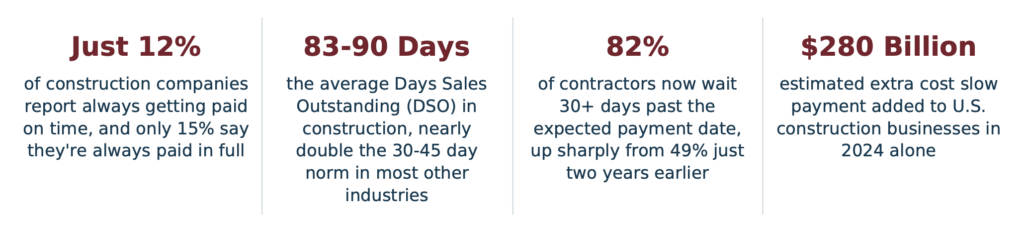
Fewer than one in eight construction companies ever gets paid on time. In 2024, 82% of contractors waited more than 30 days past their expected payment date — up from 49% just two years earlier. The Construction Credit & Finance Group compiled the data. The conclusion is unavoidable: slow payment has become the structural default of the U.S. construction industry, and the trend is accelerating.
The U.S. construction industry has always had a payment problem. What the data now shows is that the problem has crossed a threshold — from chronic to near-universal.
According to Levelset’s Construction Cash Flow and Payment Report, only one in eight construction companies ever receives payment on time. That baseline alone would constitute a crisis. But the trend line is what demands attention: in 2022, 49% of contractors reported waiting more than 30 days past their expected payment date. By 2024, that figure had surged to 82%. A 33-percentage-point deterioration in two years is not a cyclical blip. It signals something structural breaking down in how money moves through construction’s layered project chains.
The mechanics of that breakdown are well understood. Work performed on day one may not generate cleared funds until day 75 or beyond — after pay applications, third-party certification, owner approval, and multiple accounts payable cycles have each consumed their share of the calendar. CreditPulse’s 2025 industry benchmarks put construction’s average Days Sales Outstanding at 83 to 90 days, a figure corroborated by research from Levelset and Rabbet. That’s nearly double the 30-to-45-day norm operating across most other major industries.
The cost of that gap is not abstract. Slow payment added an estimated $280 billion in extra costs to U.S. construction businesses in 2024 alone. For a mid-sized firm processing $2 million in monthly invoices, carrying $3 million in outstanding receivables is a predictable consequence of today’s payment environment — one that generates $75,000 to $120,000 in annual financing costs simply to bridge the wait.
Subcontractors absorb the worst of it. A 2026 industry report found only 5% of subcontractors get paid on time. General contractors are six times more likely than material suppliers to receive payment within 30 days — a disparity that reflects how leverage, not fairness, determines who waits longest in the payment chain.
The Construction Credit & Finance Group compiled this research to make one argument clearly: a business managing receivables against assumptions formed two or three years ago is under-responding to a significantly more difficult environment.
If your firm’s Days Sales Outstanding exceeds 45 days, you’re already behind the cross-industry curve — and approaching construction’s own troubled average of 83 to 90 days. Benchmarking your current DSO is not optional. It’s the starting point for any collections strategy worth having.
With 82% of contractors experiencing routine delays beyond 30 days, handling slow payment case by case is like bailing water with a teaspoon. Proactive outreach, defined escalation timelines, and standardized follow-up protocols need to be built into your operations — not triggered by crisis.
Mechanics lien rights exist precisely because subcontractors sit at the most disadvantaged position in the payment chain. With only 5% receiving on-time payment, preserving lien rights from the first day of every project is a core financial protection — not a last resort.
— Curtis Forte, CEO, Construction Credit & Finance Group (CCFG)
That assessment is backed by the numbers. The 33-point jump in contractors reporting delays beyond 30 days — from 49% in 2022 to 82% in 2024 — is one of the sharpest documented deteriorations in payment performance across any major U.S. industry in recent years. CCFG’s position is that this data doesn’t argue for patience or optimism. It argues for proactive collections infrastructure built around current conditions, not the more forgiving environment that existed before 2022. For construction businesses still calibrating their receivables management to older norms, the gap between assumption and reality is now large enough to be a material financial risk.
The Construction Industry’s Slow Pay Crisis was compiled by the Construction Credit & Finance Group (CCFG) as an analytical synthesis of third-party industry research. Source data was drawn from Levelset’s Construction Cash Flow and Payment Report, CreditPulse’s 2025 Industry Benchmarks, and corroborating research from Rabbet. No independent primary survey data was collected. The study was designed to benchmark current payment conditions across U.S. commercial construction, quantify the financial impact of payment delays, and provide actionable guidance for construction businesses managing receivables in an increasingly slow-pay environment. CCFG serves construction companies nationwide.
Q: What does the data say about how common late payment really is in construction? Extremely common — and getting worse. According to Levelset’s Construction Cash Flow and Payment Report, fewer than one in eight construction companies ever gets paid on time. By 2024, 82% of contractors reported waiting more than 30 days past their expected payment date, up from 49% in 2022.
Q: How does construction’s payment timeline compare to other industries? Construction’s average Days Sales Outstanding runs 83 to 90 days, according to CreditPulse’s 2025 industry benchmarks — nearly double the 30-to-45-day norm across most other major sectors. That gap reflects the layered, multi-party approval process built into nearly every construction project.
Q: Why do subcontractors get paid so much later than general contractors? Position in the payment chain matters enormously. Owners pay general contractors first; GCs pay subcontractors; subcontractors pay down the line from there. A 2026 industry report found only 5% of subcontractors receive on-time payment, and general contractors are six times more likely than material suppliers to see payment within 30 days.
Q: What is slow payment actually costing construction businesses? In 2024, slow payment added an estimated $280 billion in extra costs to U.S. construction businesses nationwide. At the firm level, a mid-sized company processing $2 million in monthly invoices can expect to carry $3 million in outstanding receivables at any given time — generating $75,000 to $120,000 in annual financing costs just to bridge the gap.
Q: When should a construction business engage a collections specialist? Before accounts become critically aged. Recovery probability drops sharply once receivables pass the 90-day mark. Engaging a collections partner with construction-specific expertise earlier in the process — not as a last resort — materially improves outcomes. CCFG specializes in exactly this work.
The data is unambiguous: 82% of contractors are waiting more than 30 days past their expected payment date. The $280 billion cost of that waiting falls on businesses that weren’t built to absorb it. The Construction Credit & Finance Group works with construction companies nationwide to build proactive receivables strategies calibrated to how the industry actually pays — not how it used to.
Don’t wait until accounts are critically aged to act.

Stay up to date with the latest developments, trends, and insights impacting construction credit, collections, and payment practices.

Quick access to official state corporation databases to verify business entities, research companies, and support informed credit decisions.